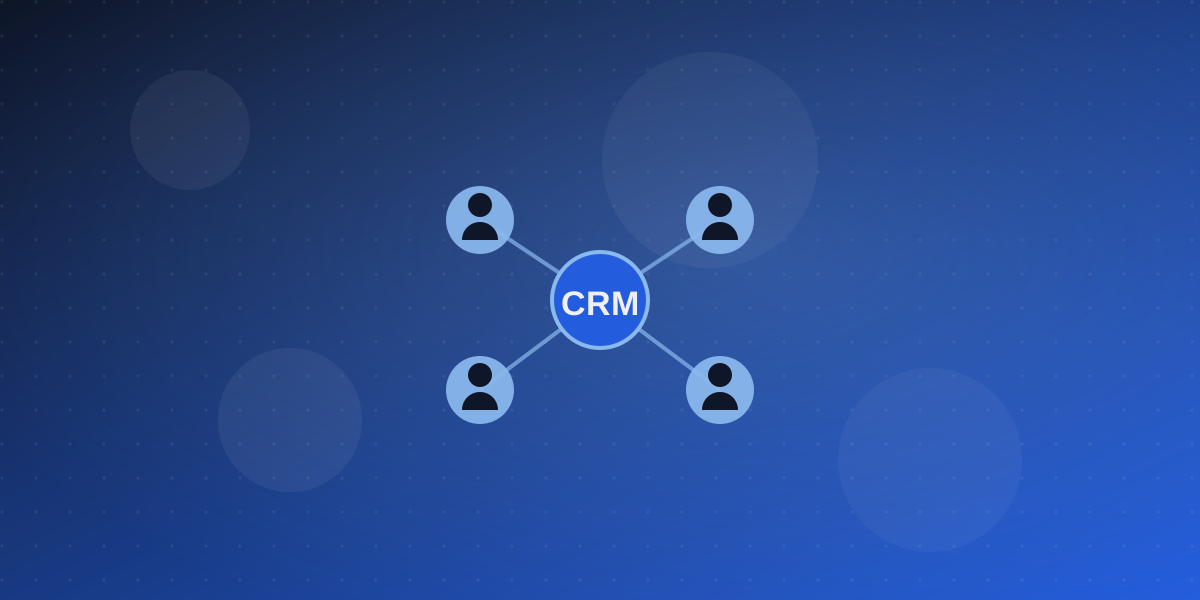
Off-the-shelf CRMs like Salesforce and HubSpot are the right answer for most companies — until per-seat pricing, rigid workflows, or features you will never use start costing more than they save. A custom CRM built around how your team actually sells typically runs between $30,000 and $150,000, and the question worth answering first is whether you have genuinely outgrown the tools you can simply subscribe to.
When a custom CRM is worth building
Building beats buying when your sales or service process is a real competitive advantage that generic software flattens, when per-seat fees are scaling faster than your revenue, or when you are stitching together spreadsheets and workarounds to cover what your current tool cannot do. If a subscription CRM fits your process with light configuration, build nothing — buy it.
- Number of modules — contacts and deals are cheap; add quoting, support tickets, and reporting and the cost climbs.
- Integrations — email, calendar, accounting, telephony, and your product data each add work.
- Automation and workflows — the rules that make a CRM save time are where much of the value and cost live.
- Users and roles — permissions, teams, and audit trails add complexity behind the scenes.
- Data migration — moving history cleanly out of your old system is a real, often underestimated line item.
Realistic 2026 ranges
- Focused CRM (contacts, deals, basic pipeline for one team): roughly $30,000–$60,000.
- Full CRM (multiple modules, automation, several integrations): roughly $60,000–$120,000.
- Complex CRM (custom workflows, many integrations, large team): $120,000–$150,000+.
- Ongoing: budget for hosting, support, and iteration — a CRM is a living system, not a one-time build.
You do not build a custom CRM to replace Salesforce feature for feature — you build it to fit the one process Salesforce makes you fight.
The pragmatic path
You rarely need to rebuild everything at once. The lowest-risk route is a focused first version around your highest-value workflow — the part where the off-the-shelf tool hurts most — launched quickly and expanded on real feedback. You own the roadmap and the data, with no per-seat ceiling on growth. Built with clean architecture and proper migration, a custom CRM stops being a cost centre and becomes the system your business actually runs on.